
A floor that gives way does not always warn in a spectacular way. Structural failures develop over months, sometimes years, through signs that most occupants attribute to the normal aging of the building. Identifying these signals early radically changes the nature of the intervention, between targeted reinforcement and emergency evacuation.
Deformation of wooden floors: what a floor that flexes underfoot reveals
The first noticeable alert without any instruments remains the sensation of abnormal softness underfoot. A healthy wooden floor transmits a firm rigidity. As soon as an area begins to flex, bounce, or vibrate when walked on, the load-bearing capacity of the joists is likely compromised.
This loss of rigidity can have two distinct origins. The first is mechanical: a cracked joist, a degraded beam support in the wall, or a joint whose tenons have loosened over the decades. The second is biological, and it is more insidious.
Building pathology specialists have reported for several years a rise in cases of wood-decaying fungi such as dry rot after prolonged untreated infiltrations. These organisms destroy the mechanical resistance of the joists from the inside. A floor may appear intact on the surface while the load-bearing wood has lost a substantial part of its useful section.
To delve deeper into the signs of floor collapse on Alpha Immobilier, the distinction between superficial degradation and structural damage is the starting point for any reliable diagnosis.
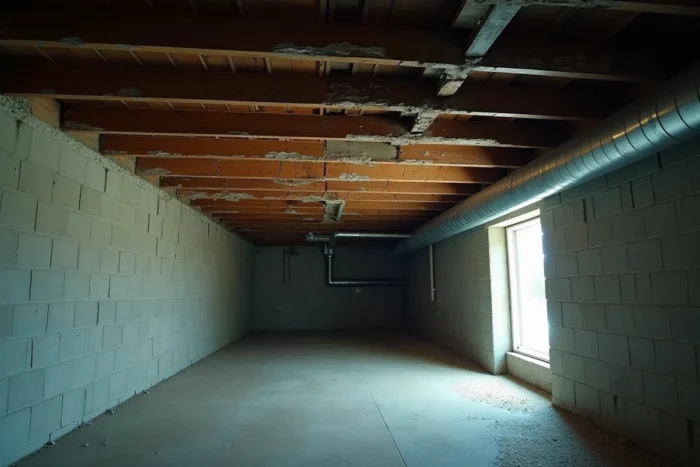
Cracks on load-bearing walls and around beams: reading visible signs
Not all cracks are equal. A shrinkage micro-crack in a new coating has nothing to do with a diagonal crack that runs through a load-bearing wall from side to side. Location, orientation, and evolution over time are the three criteria that separate the benign from the critical.
Cracks related to foundation settlement
When foundations settle unevenly, load-bearing walls deform and take the floors they support with them. Cracks then appear diagonally, often starting from the corners of windows or doors, because these openings constitute points of weakness in the masonry.
- Stair-step crack in a brick or block wall: it follows the mortar joints and indicates differential movement between two areas of the building.
- Horizontal crack at the level of a chain or slab: it may indicate that the floor is separating from the wall, reducing its lateral support.
- Vertical crack along a beam end (where the joist rests in the wall): it signals that the supporting masonry is crumbling, decreasing the load-bearing surface.
A crack that widens over the weeks deserves monitoring with a witness (a simple plaster placed across is enough to detect any movement). If the witness breaks, the movement is active, and a structural diagnosis becomes a priority.
Cracks in the ceiling of the lower level
The ceiling located beneath a weakened floor often reveals the problem before the floor itself. Straight cracks that follow the axis of the joists, accompanied by slight visible sagging in low light, indicate that the beams are flexing beyond their normal limit.
Cracking noises and sound signs of a weakened floor
A wooden floor naturally creaks due to variations in temperature and humidity. This type of noise, dry and brief, often occurs at night when the temperature drops. It does not necessarily indicate a structural defect.
On the other hand, a dull, prolonged creak that repeats under load (the passage of a person, moving furniture) tells a different story. This sound comes from a wood fiber that is gradually breaking, or from a joint that is shifting because it has lost its original geometry.
Occupants sometimes describe a new squeak that appeared after water damage or a prolonged episode of humidity. This change in the acoustic behavior of the floor is an indicator to take seriously, as it confirms that the structure has undergone a modification of its mechanical properties.
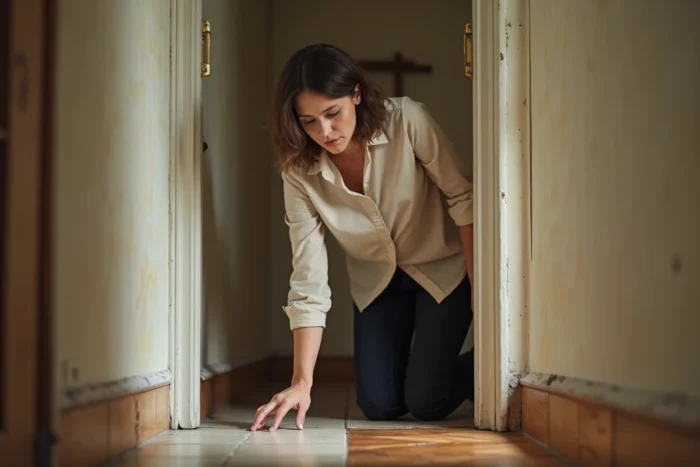
Water infiltrations and humidity: the aggravating factor for wooden and concrete floors
Water remains the primary enemy of floors, regardless of their material. On a wooden floor, persistent humidity feeds wood-decaying fungi and wood-eating insects (powderpost beetles, woodborers). On a reinforced concrete floor, it causes corrosion of the metal reinforcements, which swell as they rust and cause the surrounding concrete to spall.
Home insurers now require more frequent structural inspections for older condominiums, as the rise in claims related to water infiltration and floor degradation has been deemed concerning for several years. This insurance pressure pushes condominium associations to document structural pathologies (cracks, infiltrations, slab settlements) more systematically.
- A recurring moisture stain on the ceiling, even slight, indicates a point of water entry that reaches the load-bearing structure.
- A localized musty smell in a specific room may betray the presence of dry rot or coniophore in the insulation or under the floor covering.
- A localized swelling of the floor covering (lifting parquet, tiles) indicates that the structural support underneath has moved or deformed.
- Water droplets on the ceiling, even sporadic, justify immediate investigation of the upper side of the floor.
Structural diagnosis of the floor: when and how to act
The main difficulty remains distinguishing an aesthetic disorder from a real risk of collapse. A floor can exhibit creaks, slight deformations, and some cracks without its load-bearing capacity being compromised. Field feedback varies on this point: some professionals consider that a deflection (curvature) greater than one three-hundredth of the span justifies reinforcement, while others apply different thresholds depending on the type of building.
The most reliable approach is to involve a structural engineering firm or a building pathology expert. This professional conducts a visual survey, probes the wood (with a punch or moisture meter), and checks the supports in the walls. If the floor is concrete, they can perform measurements of carbonation and corrosion of the steels.
An early diagnosis costs a fraction of the price of a complete structural overhaul. Waiting for a floor to show a visible deflection to the naked eye often means intervening when the joists have already lost a significant part of their resistance. The first signs (softness underfoot, new noises, micro-cracks at the supports) are enough to trigger a technical visit, without waiting for an imminent danger situation.