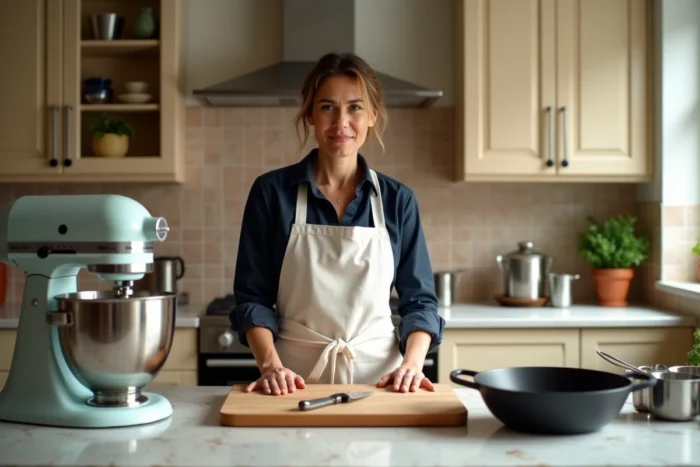
A knife that doesn’t glide well, a pan that sticks after three months, a silicone mold that warps after the first bake: these common problems are rarely due to a recipe error. Choosing kitchen equipment based on specific technical criteria radically changes the consistency of results, whether preparing everyday dishes or demanding pastry recipes.
Safety and standards of kitchen utensils: points to check
Riveted handles rather than glued or screwed remain the first indicator of strength on a utensil. A glued handle eventually detaches after a few cycles in the dishwasher. Riveting, on the other hand, holds mechanically without relying on a heat-sensitive adhesive.
The second often overlooked point: the presence of a non-slip surface under cutting boards. This detail significantly reduces the risk of slipping during heavy cuts. Third check, the thermal resistance of the handle or grip must correspond to actual use (oven, induction cooktop).
The European Commission is working on a revision of the rules regarding materials in contact with food. The migration of substances (plasticizers, PFAS) into food is at the center of this overhaul. Prioritizing stainless steel, cast iron, or food-grade silicone over low-quality plastics now allows for anticipating these regulatory changes.
To explore in detail the equipment available on 75cl, we recommend systematically comparing technical sheets before finalizing a cart.
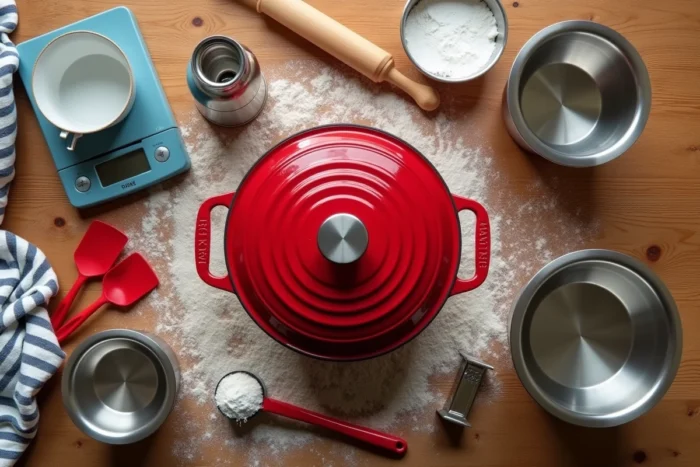
Cooking materials: stainless steel, cast iron, and non-stick coatings compared
Stainless steel does not react with any food and withstands all heat sources, including induction. Its only requirement: a bit of fat and a gradual increase in temperature so that proteins do not stick to the surface.
Cast iron, whether raw or enameled, remains the reference material for long cooking. Braised, stewed, slow-roasted: its thermal inertia ensures even heat distribution. Its main drawback is its heavy weight, but that is precisely what makes it effective.
Recent comparative tests on non-stick pans show that the durability of coatings varies greatly from one brand to another, even at comparable prices. A well-maintained stainless steel or cast iron pan matches or even exceeds the lifespan of an average mid-range non-stick. Investing in a durable material costs less than replacing a pan every year.
Comparison table of materials
| Material | Main advantage | Limitation | Maintenance |
|---|---|---|---|
| 18/10 Stainless Steel | Total versatility, chemical inertia | Possible sticking without fat | Dishwasher, stainless steel cleaner |
| Raw Cast Iron | Heat retention, powerful searing | Weight, seasoning required | Hot water, no harsh detergent |
| Non-stick (PTFE) | Cooking with low fat | Limited lifespan, sensitivity to scratches | Soft sponge, no metal |
| Food-grade Silicone | Flexibility, perfect release (pastry) | No searing possible | Dishwasher |
Kitchen knives: three blades are enough for most preparations
It’s tempting to accumulate knives. However, three blades cover almost all needs in home and semi-professional kitchens:
- A chef’s knife of 20 to 24 cm: slicing, chopping, dicing. This is the blade that stays in hand the longest, the one that structures the entire preparation.
- A paring knife (8 to 10 cm): peeling, turning vegetables, making precision cuts on small volumes.
- A serrated bread knife: slicing without crushing airy crumbs, but also neatly cutting tomatoes and citrus fruits.
The quality of the steel is more important than the number of pieces in the block. High-carbon steel retains its sharpness for a long time, at the cost of regular maintenance (sharpening with a steel, immediate drying after washing). Molybdenum-vanadium stainless steel offers a solid compromise between corrosion resistance and edge retention.
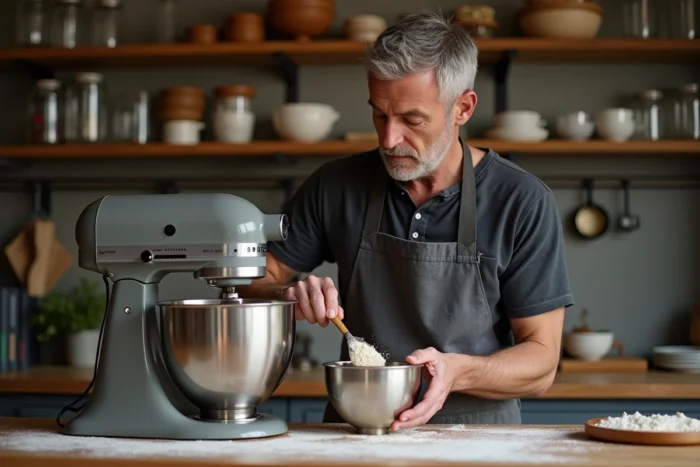
Molds and pastry equipment: silicone or metal depending on the recipe
Food-grade silicone is suitable for mousses, bavarois, and entremets due to its flexibility for release. For yeast doughs, cakes, and tarts, a metal mold conducts heat better and promotes an even golden crust.
We recommend the same rigor for piping bags and tips. A reusable soft polyurethane bag, paired with a set of stainless steel tips (plain, star, Saint-Honoré), covers most decorations. Plastic tips deform under pressure and do not allow for clean work with buttercream or meringue preparations.
Selection criteria for molds
- Metal thickness: a mold that is too thin distorts heat and creates overcooked areas.
- Coating: non-stick facilitates release, but buttering and flouring remain more reliable for genoise cakes.
- Thermal compatibility: check the maximum temperature supported, especially for silicone (some models do not exceed 200 °C).
The proportion of French households that have replaced at least one plastic utensil with an alternative made of wood, stainless steel, or food-grade silicone is clearly increasing, driven more by health concerns than by ecology. This shift also affects pastry equipment, where quality silicone molds are gaining ground against rigid plastic models.
A mold that doesn’t stick, a knife that cuts cleanly, and a pan that reacts as expected eliminate extraneous variables. The consistency of results depends as much on the equipment as on the technique.