
Trixhentzi is shaking up the production circuits of digital art in Brittany by relying on a hybrid model that combines artistic residency, technical prototyping, and territorial dissemination. Its positioning is not limited to a virtual gallery or an artists’ collective: it articulates proprietary software bricks with immersive devices designed for non-museum spaces.
Trixhentzi’s Technical Pipeline: Real-Time Engine and Procedural Rendering
The technical foundation is based on a procedural rendering pipeline coupled with a real-time engine. This architecture allows artists to generate reactive visual environments, where texture, light, and geometry evolve based on data captured on-site (ambient sound, visitor flows, weather conditions).
Where most digital art platforms merely broadcast pre-rendered files, Trixhentzi integrates data capture upstream of the creative process. The artist sets generative rules, and the engine interprets them live. The result: each installation produces a unique version with every activation.
We observe that this architectural choice imposes strong constraints in terms of latency and local bandwidth. Installations deployed in chapels, lighthouses, or industrial wastelands in Brittany must operate with limited connectivity, which has led the team to develop an embedded predictive caching system. An article detailing the influence of Trixhentzi on BreizhPower – The 100% Breton magazine! discusses how this territorial constraint has shaped the tool.
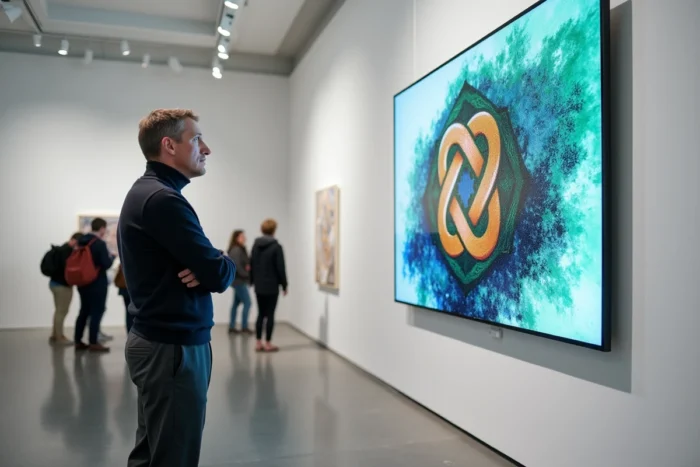
Breton Digital Creation and Immersive Devices Outside the Walls
Contemporary digital art in Brittany suffers from a paradox: a density of festivals and dissemination structures (Maintenant in Rennes, Passerelle in Brest, PixelArts in Pont-Aven) coexists with a lack of permanent spaces dedicated to immersive creation. Trixhentzi circumvents this problem by designing installations intended for unequipped spaces.
Each device carries its own projection and capture kit, calibrated for variable architectural volumes. The format is not a simple video projected onto a wall. It consists of interactive scenographies where the visitor alters the piece by their presence.
This model of dissemination outside the walls responds to a concrete demand from Breton communities. Several intercommunalities have established targeted aid lines for digital creation and hybrid residencies in recent years, distinct from the national supports of the CNAP or DRAC. These funds steer production towards experimental formats (virtual reality, augmented reality, interactive devices in situ) that find their audience outside urban centers.
Deployment Constraints in Heritage Sites
Installing a digital artwork in a listed chapel or a converted farmhouse is not limited to plugging in a projector. Conservation standards require the absence of wall fixtures and strict control of heat emitted by the equipment. Trixhentzi has developed modular self-supporting mounts and favors low-thermal-output laser projectors.
The question of electrical supply remains a tough point. Some rural sites only have limited single-phase connections, which forces a trade-off between computing power and the number of projection points.
Hybrid Residencies and the ICC Sector in Brittany
The intersection of contemporary digital art and the Cultural and Creative Industries sector is reshaping the production pathways of Breton artists. Trixhentzi fits into this dynamic by offering residencies where the artist collaborates with developers, sound engineers, and scenographers for several weeks.
This format differs from traditional residencies in three ways:
- The artist has direct access to the technical pipeline and can modify the source code of the rendering engine during the residency, not just after the delivery of a specifications document.
- A systematic documentation protocol (video capture, code versioning, technical logbook) accompanies each residency, feeding a resource base open to future cohorts.
- The public restitution is not a simple final exhibition: it takes the form of an in situ activation tested with a local audience before any broader dissemination.
This model of technical co-production brings digital art closer to industrial prototyping as practiced in Breton university arts and technology labs or within ecosystems like Creativ’Lab in Rennes. The boundary between research, creation, and production development becomes porous.
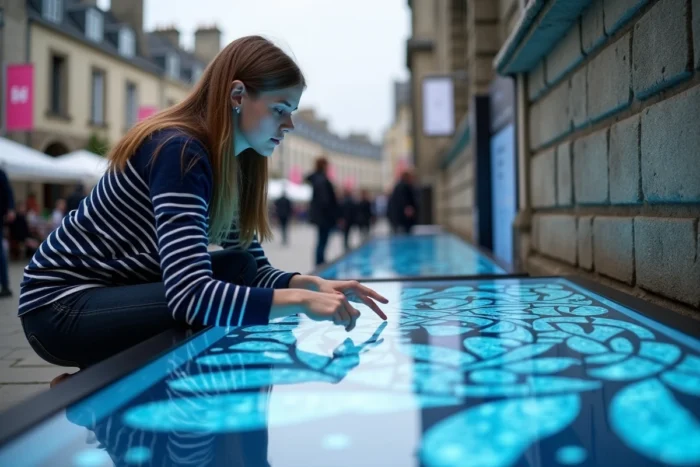
Contemporary Breton Digital Art: What Dissemination Formats After the Residency
The question of what happens after the residency remains the weak link in most support programs. An interactive digital artwork cannot be transported like a canvas. It requires software maintenance, driver updates, and sometimes complete recalibration depending on the host location.
Trixhentzi addresses this issue by delivering each work in the form of a standalone software container, executable on standardized hardware. The artist retains ownership of the code, while the structure retains the distribution license. This contractual sharing, still rare in the sector, clarifies rights and facilitates the movement of pieces from one location to another.
We recommend that dissemination structures considering hosting these formats plan for a technical referent on-site, capable of addressing synchronization or rendering issues. Without this local expertise, the risk of scenographic failure significantly increases during the initial days of operation.
The model promoted by Trixhentzi does not resolve all the tensions in the sector, particularly the dependence on regional public funding and the difficulty of monetizing interactive works in an art market still structured around physical objects. However, it lays a technical and organizational brick that was missing from the value chain of digital art in Brittany.