
Trimming a dead branch three meters high, shortening a fruit tree that overhangs into the neighbor’s yard, clearing a path through a tall hedge: these situations require a precise tool, not a standard chainsaw resting on the ground. The pole saw meets this need, but the available models vary so much in power, cutting length, and weight that a poor choice quickly results in fatigue or mediocre results.
Brushless motor on battery pole saw: why this point changes everything
You may have noticed that some battery pole saws barely last half an hour, while others can make cuts for over an hour? The difference often comes from the type of motor used.
Recent models increasingly incorporate a brushless motor. Compared to the brushed motors found on entry-level machines, a brushless motor offers better energy efficiency, runs cooler, and reduces breakdowns related to carbon wear. In practical terms, the battery lasts longer for the same job, and the machine requires less mechanical maintenance.
Before purchasing, check for this mention in the technical specifications. A slightly more expensive model with a brushless motor will pay off over time, especially if you prune several times a season. Recent comparisons confirm that this technology has become a reliable selection criterion for demanding individuals. The catalog available at elagueuse-warrior.com makes it easy to compare these features across different models.
Classic pole saw or telescopic pole saw: adapting the tool to the cutting height
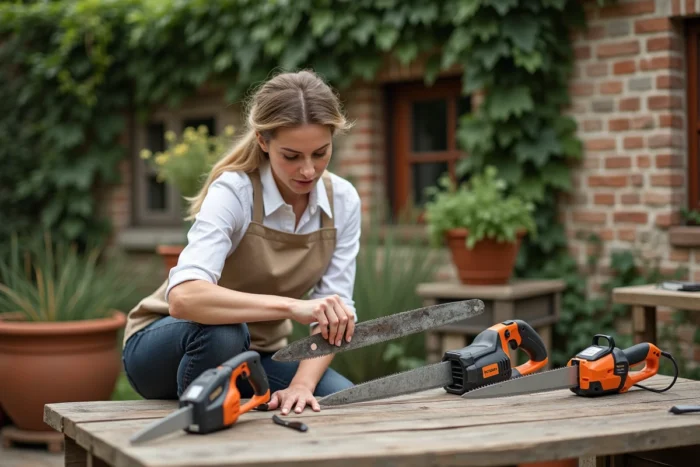
A classic pole saw (known as “top handle”) is operated with one hand and is suitable for high work from a ladder or harness. It is compact, lightweight, and allows for precise cuts on medium-diameter branches.
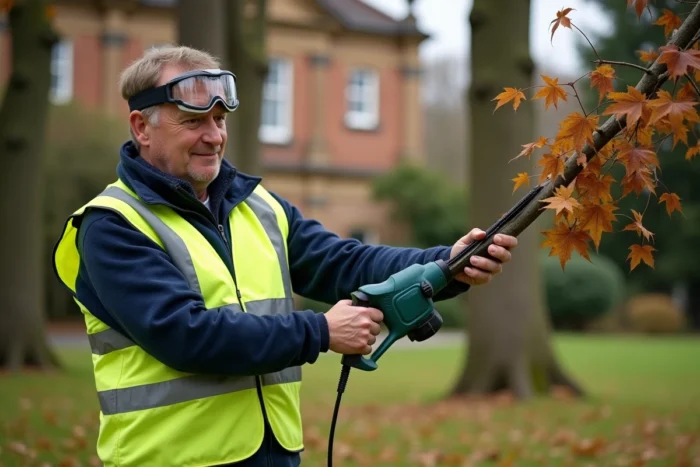
The telescopic pole saw, on the other hand, is used from the ground. The cutting head is mounted at the end of a telescopic handle that can reach several meters in total length. You keep both feet on the ground, which radically changes the safety of the operation.
How to choose between the two
- Frequent high work without a lift: the telescopic pole saw avoids the use of a ladder and limits the risk of falling, an important point for an individual working alone
- Branches accessible from a stable ladder, moderate diameter: the classic top handle pole saw offers more maneuverability and precision for routine maintenance cuts
- Tall trees with thick branches: some motorized telescopic pole saws accept chain guides long enough to cut hardwood, but the weight at the end of the pole can quickly lead to fatigue
For a medium-sized garden with a few fruit trees and hedges, a battery-operated telescopic pole saw covers most needs without requiring height access equipment.
Noise regulations in residential areas: an often-overlooked criterion
Several French municipalities now restrict the use of gas-powered machines in residential areas. Limited time slots, or even partial bans, apply according to municipal decrees. If you live in a housing estate or a dense suburban area, check local restrictions before investing in a gas-powered model.
This constraint drives many individuals towards battery-operated pole saws for routine maintenance. Gas-powered machines remain relevant for heavy work in rural areas or for professionals dealing with hardwood all day. For a standard garden, a battery model with a brushless motor represents the best compromise between power, silence, and regulatory compliance.
Guide bar, chain tension, and safety: the technical details that matter
The length of the guide bar determines the maximum diameter of the branch you can cut in a single pass. A guide that is too short forces you to strain or maneuver around the branch, which prematurely wears out the chain and increases the risk of kickback.
Chain tension and sharpening
A poorly tensioned chain is the leading cause of accidental cuts among occasional users. Before each session, check that the chain is not sagging under the guide but remains free to turn by hand without force. Some recent models offer a tool-free tensioning system, which is faster and more reliable than a traditional adjustment key.
Regular sharpening of the chain is equally crucial. A dull chain no longer cuts; it tears the wood. The motor works harder, the battery drains faster, and the cut is uneven. A few passes with a round file suited to the chain pitch every few uses is enough to maintain cutting efficiency.
Personal protective equipment
- Cut-resistant gloves suitable for cutting work (EN 381 standard)
- Safety glasses or face shield against chip projections
- Noise-canceling helmet if using a gas-powered model, recommended even with a battery machine during prolonged sessions
- Safety harness mandatory if working at height with a top handle pole saw
Manual pole saw: the alternative without motorization
Manual long-reach pole saws are emerging as a zero-fuel and zero-battery solution. These tools with blades or saws extend several meters and allow for cutting small-diameter branches without any power source.
For thin branches and occasional use, the manual pole saw is more than sufficient. It makes no noise, requires no motor maintenance, and costs a fraction of the price of a motorized model. However, as soon as the diameter of the branch exceeds a few centimeters, the physical effort quickly becomes discouraging.
This option complements a motorized pole saw rather than replacing it. A gardener equipped with a manual pole saw for small maintenance cuts and a battery-operated pole saw for heavier work covers almost all situations encountered in a residential garden, without relying on a single tool for everything.