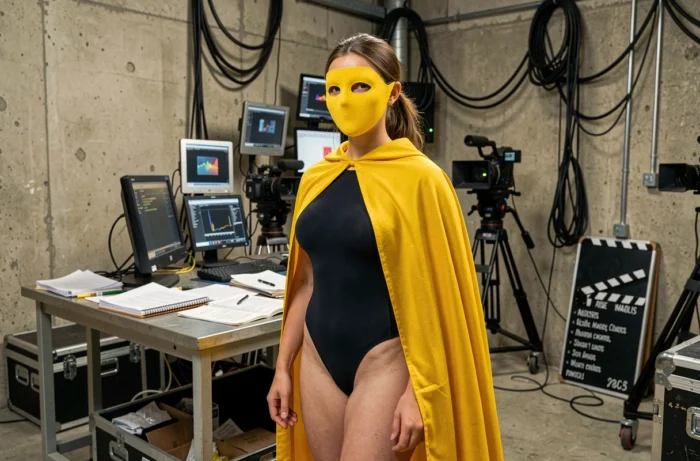
Fantômette is a character from children’s literature created by Georges Chaulet, first appearing in 1961 from Hachette. A masked vigilante, she has particularly marked several generations of readers through dozens of novels before being adapted for both small and big screens. Her appearances in film raise specific production questions, from the transposition of the drawn character to a filmed universe to the production choices that shaped each version.
Fantômette and the Difficulty of Adapting a Masked Literary Character
Adapting a masked character poses a concrete staging problem. In Chaulet’s novels, Fantômette’s identity relies on a narrative game: the reader knows that Françoise Dupont is hiding behind the mask, but the other characters do not. On screen, this mechanism clashes with the camera, which shows everything.
The costume itself, with its cape and black mask, must remain visually readable without falling into parody. Each adaptation had to redefine the balance between fidelity to the book and visual credibility. The television series aired in the 1990s opted for a light tone, close to a children’s soap opera, while more recent projects have sought to modernize the character to reach a broader audience.
This tension between the original text and its filmed translation explains why the films featuring Fantômette remain objects of curiosity for fans of children’s cinema. The technical challenge is not the budget or special effects, but the ability to make a character whose face is partly hidden endearing.
European Coproduction and Financing of Fantômette Adaptations
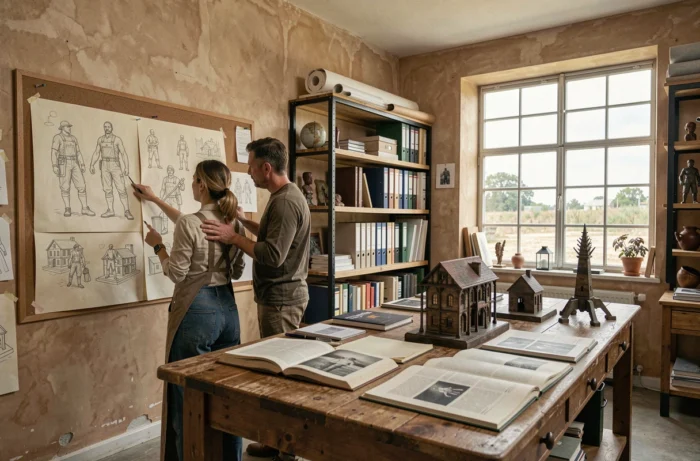
The financing of audiovisual adaptations of characters from French children’s literature often follows a European coproduction model. This model, well documented in the case of other French franchises from the 1960s and beyond, brings together producers from several countries to pool costs and facilitate international distribution.
The Fantômas trilogy from the 1960s, often confused with Fantômette despite the lack of connection between the two characters, illustrates this mechanism. Its production notes mention Italian producers alongside French producers, as part of a typical Franco-Italian coproduction of the time. This financial arrangement allowed access to studios, technicians, and distribution networks in several countries simultaneously.
For Fantômette adaptations, the logic is comparable on a smaller scale. Television series aimed at children benefit from cross-financing between French channels and European partners. This production framework directly influences creative choices: filming locations, episode length, shooting language.
Consequences on Visual Style
When a film or series relies on multiple national funders, the director must navigate sometimes contradictory requirements. A French broadcaster may request a Parisian setting where a foreign coproducer prefers more “generic” backgrounds to facilitate export.
This constraint translates onscreen into set choices that oscillate between recognizable French suburbs and more neutral studio interiors. The visual style of an adaptation depends as much on the financial arrangement as on the director’s vision.
Behind-the-Scenes Secrets of Costumes and Stunts in Fantômette Series
The costume of Fantômette, in its filmed versions, has posed practical problems that the novels did not have to resolve. On set, a cape that gets caught on a prop or a mask that limits the actress’s field of vision slows down each take.
- The cape has generally been shortened compared to the illustrations in the books, to allow for running scenes and stunts without the risk of snagging
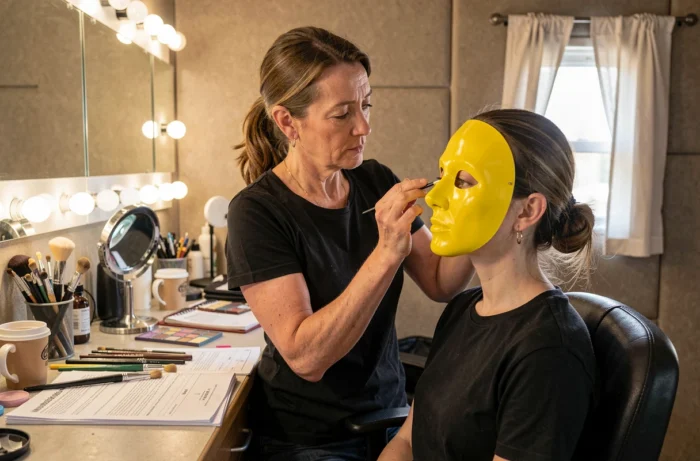
- The mask (half-mask) has been secured by a system of invisible attachments to the camera, often retouched between takes to prevent it from slipping
- Stunt scenes were filmed with doubles in wide shots, while close-ups showed the lead actress wearing the mask in a static position
Stunts remain the most time-consuming aspect of filming a children’s series featuring a masked character. Unlike an action film for adults, the safety standards applied to a production aimed at children impose stricter protocols, which lengthens shooting days.
Fantômette vs. Fantômas: Frequent Confusion and Distinct Legacies
The phonetic proximity between Fantômette and Fantômas causes recurring confusion. The two characters have no narrative or legal connection. Fantômas, created in 1911 by Pierre Souvestre and Marcel Allain, is a bloodthirsty criminal. Fantômette, created fifty years later by Georges Chaulet, is a teenage vigilante.
Their film adaptations have followed very different trajectories. The Fantômas trilogy featuring Jean Marais and Louis de Funès transformed the literary character into a gadget-laden adversary, akin to a spy film. The blue mask and black gloves of Fantômas are an invention of the 1960s films, absent from the original novels. This iconography has permanently fixed the popular image of the character.
Fantômette, on the other hand, has never benefited from a comparable big-budget feature film. Her adaptations have remained within the television and editorial realm. The difference in treatment reflects a positioning gap: Fantômas targeted the adult mainstream audience, while Fantômette was aimed at young readers.
A Legacy That Weighs on New Projects
Any adaptation project of Fantômette must contend with the overshadowing presence of Fantômas in the collective imagination. Production teams face a communication challenge as much as a creative one: to explain that the character is not a female version of Fantômas, but an autonomous universe with its own mythology.
This work of distinction involves choices of tone, visual palette, and narration that deliberately distance Fantômette from the dark police genre. Bright colors, a soap-opera rhythm, and the character’s school setting serve precisely to mark this separation.
Upcoming adaptations of Fantômette will likely have to choose between fidelity to the original material and modernization of the character for an audience accustomed to international superheroines. The costume, the mask, and the dual identity remain powerful narrative tools, provided the production finds the right balance between homage and renewal.