The question of whether to wear a cap while running arises with each change of season. Rather than making a quick decision, it is more useful to compare what this accessory actually provides against what it does not cover, by crossing dermatological recommendations and the technical constraints related to running.
Running cap and sun protection: what the indices reveal
Most runners associate the cap with protection against the sun. The visor does indeed protect the eyes and part of the face from direct rays. However, a classic baseball cap leaves the ears, neck, and nape completely exposed.
The American Academy of Dermatology recommends prioritizing clothing with a UPF rating to assess the UV protection of a textile. A cap without a UPF mention poorly filters the ultraviolet rays that pass through the fabric, even if the visor blocks visible light.
| Criterion | Running Cap | Wide-Brimmed Hat |
|---|---|---|
| Face Protection | Good (front visor) | Good (full brim) |
| Ear Protection | Absent | Covered by the brim |
| Nape Protection | Absent | Covered by the back brim |
| Ventilation | High (frequent mesh panels) | Variable by model |
| Stability while Running | Good (lightweight, adjustable) | Average (wind resistance) |
| Compatibility with Sunscreen | Additional necessary on exposed areas | Reduces the area to protect |
The table highlights a often underestimated point: the cap does not eliminate the need to apply a broad-spectrum, water-resistant sunscreen of at least SPF 30 on all uncovered areas. This is even more true as UV rays justify protection from a rating of 3 to 5, including on cloudy or cool days.
The choice to run with a cap therefore depends on the context: in road races under strong sunlight, it is not sufficient alone, but it remains a useful first level of protection combined with other measures.

Ventilation and thermoregulation: does the cap really help in hot weather?
The head dissipates a significant portion of body heat. Covering this area with unsuitable fabric can worsen overheating rather than limit it.
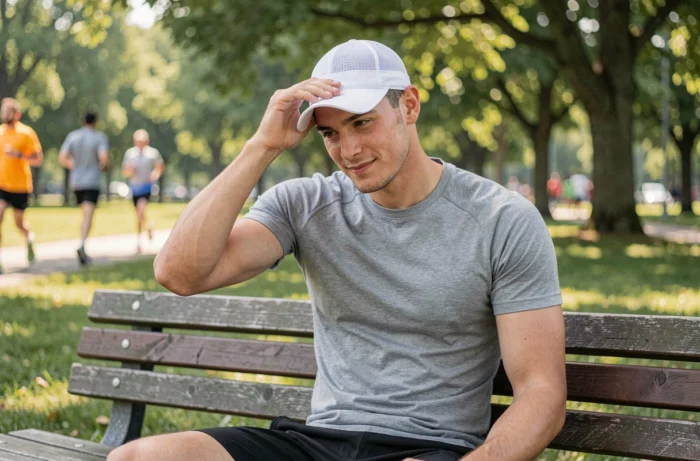
Technical running caps incorporate mesh panels and quick-drying fabrics to maintain airflow. In contrast, a thick cotton model or one without ventilation retains sweat and increases the perceived temperature under the visor.
- An absorbent inner band prevents sweat from running into the eyes, improving visibility and comfort on long runs.
- Models with side mesh cutouts provide sufficient ventilation to limit heat buildup, even above 25 °C.
- A lightweight quick-drying fabric reduces the weight of the cap soaked with sweat, avoiding the feeling of heaviness after several kilometers.
The material matters more than the presence or absence of a cap. A well-ventilated technical cap protects without trapping heat. An unsuitable model produces the opposite effect.
Trail running and altitude: where the cap alone becomes insufficient
In the mountains, UV exposure increases with altitude. Snow strongly reflects ultraviolet rays, intensifying irradiation on the face, including from below, where the visor covers nothing.
For trail outings above the tree line, specialized recommendations for UV protection at altitude suggest complementing the cap with UV-filtering sunglasses and UPF clothing. The cap then plays a partial role in a broader system.
In cold and windy weather, a beanie or buff offers better thermal insulation. The cap alone does not protect the ears or forehead from wind chill. Some runners layer a neck gaiter under the cap to combine sun protection and insulation, but this solution adds a layer that can hinder ventilation.
Criteria for choosing a running cap suitable for running
Rather than a universal model, the choice depends on the type of outing and the prevailing weather conditions.
Material and weight
Technical polyesters and ripstop nylons dominate the ranges of running caps. A lightweight fabric with a UPF rating reduces both weight and UV exposure. Cotton, which absorbs sweat without releasing it, remains a poor choice for running.
Fit and stability
A cap that moves with each stride becomes a source of distraction. Rear tightening systems (velcro, clip, or elastic) must keep the accessory in place without creating pressure points. For trail running, a chin strap prevents the cap from blowing away in windy sections.
Visor and field of vision
A curved, semi-rigid visor protects the eyes better than a flat visor. It channels rainwater to the sides instead of letting it run down the face. This detail significantly changes comfort during outings in the rain.
The choice of a running cap is less a question of style than a trade-off between partial sun protection, sweat management, and stability while running. On the road in hot weather, a ventilated technical cap combined with SPF 30 sunscreen covers most needs. At altitude or in marked cold, it is only one element among others in the runner’s gear.