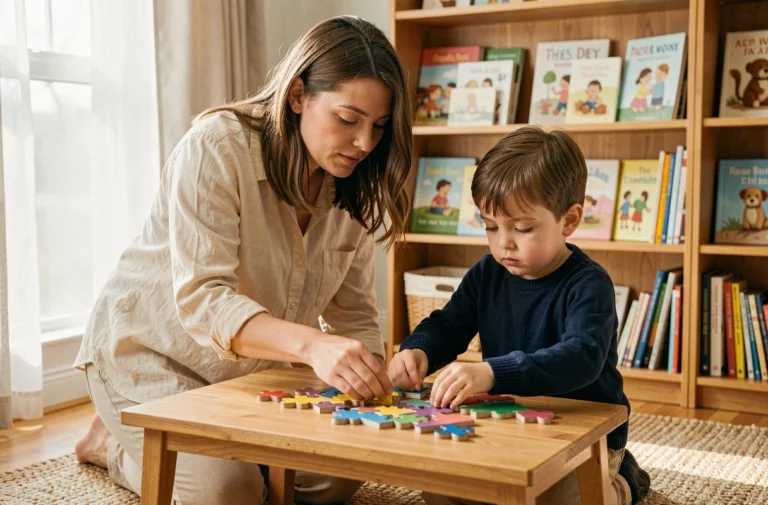
Returning to work after a birth rarely reshuffles how parents share responsibilities. A 2023 qualitative survey of fathers of children born in 2021 shows that when both parents return to work, the division of domestic and parenting tasks often becomes more unequal. Supporting dads in their family lives means addressing this turning point, not just the first few weeks with the baby.
Fathers’ work schedules and the division of parenting tasks
Fathers’ involvement is still largely shaped by work constraints. Insee notes that fathers tend to prioritize quality time (playing, reading, outings), while their contribution to household tasks depends directly on their work schedules. The problem is structural: fathers miss out on recurring, invisible tasks as soon as their schedules become more demanding.
Preparing for a father’s return to work as a family-organizing issue can change the dynamic. Before he goes back to the office, the family should agree on an explicit division of responsibilities that does not rely solely on who has more time.
- Identify tasks that need to be done regularly (preparing meals, bath time, medical appointments) and assign a primary person responsible for each, regardless of who gets home first
- Distinguish between hands-on care (diaper changes, bedtime, nights) and organizational tasks (booking appointments, tracking vaccinations, managing diaper supplies): a father can handle the planning even if he works irregular hours
- Plan for unexpected situations: who calls the daycare if the child has a fever, who takes a half-day off, and according to what criteria (not just who earns less)
Balancing work and family responsibilities is not just a challenge for mothers. According to Insee research on gender inequalities, men also report difficulties combining work with family responsibilities. We find that families who formalize this division before returning to work navigate the first few months more successfully. Resources specifically for fathers are available to explore these topics further, including https://misterpapa.fr, which brings together guides and first-hand accounts of everyday fatherhood.

Splitting parental leave: an underused option for dads
Parental leave can be split into separate periods, subject to certain conditions. For employees, a mandatory period must be taken immediately after birth leave, followed by an optional period that can be taken in several installments within six months of the birth. The rules and benefits vary depending on employment status.
Splitting leave offers a strategic option. A father who takes a few days off during weaning, the start of daycare, or a particularly exhausting period for the couple can provide more targeted support than by taking one continuous block of leave solely around the birth.
Planning split leave with your employer
This needs to be planned in advance. The father must notify his employer within the required timeframe and arrange cover for his duties while he is away. Presenting a clear plan for splitting leave can reduce pushback from management and avoid last-minute negotiations.
Self-employed workers and civil servants are subject to different rules. It is best to direct each father to the official information relevant to his employment status rather than applying a one-size-fits-all approach.
Fathers’ daily routines: beyond leisure time with the child
A common temptation for a dad who is short on time during the week is to make up for it with fun activities at the weekend. This approach creates an imbalance: the father becomes the fun parent, while the mother handles the logistics. Children absorb this division of roles, and it becomes more entrenched over time.
Build short but meaningful daily rituals
A father who gets home late can still take charge of a regular ritual, even a brief one. Evening bath time, reading before bed, or preparing breakfast for the next day can provide a daily point of connection with the child without requiring a large block of time.
What matters is not how long it lasts, but how regularly it happens. A 20-minute ritual every evening has a greater impact on the parent-child relationship than a one-off full day out. Babies and young children recognize repetition, not duration.
Take on the mental load remotely
A father who travels for work or has irregular hours can manage the mental load without being physically present. Ordering groceries online, organizing the week’s schedule, booking pediatric appointments from his phone: these organizational tasks fit around any work schedule.
Sharing the mental load requires an explicit agreement between partners. Without a prior discussion, the parent who has been managing everything continues to do so out of habit, even when the other parent is available to take things on remotely.

The father-child relationship after parental leave: preventing a gradual loss of connection
The 2023 survey of fathers of children born in 2021 highlights a recurring pattern: the intense involvement of the first few weeks gradually fades after returning to work. Disengagement is rarely sudden; it sets in through a series of small withdrawals.
The first sign is a loss of confidence in one’s own abilities. A father who no longer changes his child regularly may eventually feel less comfortable doing it than his partner. The difference in practice creates a difference in confidence, which leads to more delegation and widens the gap further.
Breaking this cycle means maintaining direct involvement in caregiving tasks, even if only to a limited extent. A father who takes sole responsibility for one daily care task (even just the morning diaper change) retains his skills and physical connection with his child.
Regular conversations between partners about how responsibilities are actually shared (not how they were meant to be shared, but how things really work) can help spot changes before they become the norm. A 10-minute monthly check-in is enough to get things back on track.