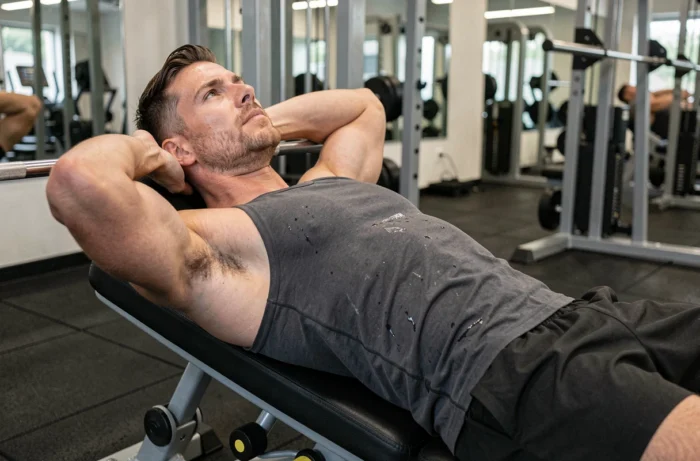
An adjustable weight bench sits unused in the corner of the gym, and most people use it mainly for bench presses. The thing is, that same bench can turn a simple floor crunch into a much more demanding core exercise—provided you choose the right movement for what you’re actually looking for: pure flexion, stability, or a gradual return after lower back discomfort.
Bench angle and abs: what the incline really changes
Inclining the bench seems like an obvious way to make the exercise harder. It increases the range of motion, gravity works against you more, and the burn kicks in sooner. But a study comparing muscle activity across several exercises found that a reverse crunch on an incline bench also heavily recruits a hip flexor. In other words, an incline doesn’t automatically improve abdominal engagement if the hip flexors take over.
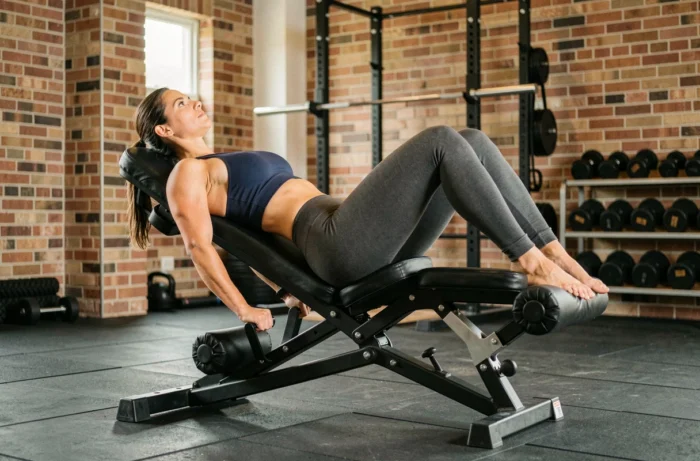
In practice, when you hook your feet under the pads of an incline bench and raise your torso, the iliopsoas takes on a large part of the load. The abs come into play mainly when your lower back lifts off the bench—not before. To work your abs on a bench while genuinely targeting the rectus abdominis, limit the lift to a partial trunk curl (raising your shoulders a few inches) rather than doing a full sit-up.
A slight incline (one or two notches) is enough to add resistance without turning the exercise into a hip movement. A steep incline is suitable for experienced trainees who already have good lumbar control, not beginners or those returning after a break.
Adapt bench exercises to your abdominal training goal
Presenting a single bench crunch routine as a one-size-fits-all solution ignores the fact that the core serves several distinct functions. The American College of Sports Medicine distinguishes isolated core work from exercises combined with limb movements. To improve athletic performance, the ACSM recommends incorporating functional movements rather than relying solely on isolated abdominal exercises.
Trunk flexion: decline bench crunch
Lie face up on a decline bench with your feet secured. The movement should be limited to curling your upper back, vertebra by vertebra, without rising all the way to a seated position. Keep your hands crossed over your chest or placed behind your ears without pulling on your neck. Three sets of 12 to 15 slow reps are more than enough for pure flexion work.
Core stability: plank with feet elevated on the bench
Place your feet on the bench and hold a plank on the floor to increase the stabilization demand compared with a standard plank.
The ACSM lists the plank, side plank, and dead bug among exercises that improve balance and coordination, including in older adults. Hold the position for 30 to 45 seconds with a neutral pelvis (neither arched nor tucked) to engage the transverse abdominis and obliques far more than fast, repeated crunches.
Leg raises on a flat bench
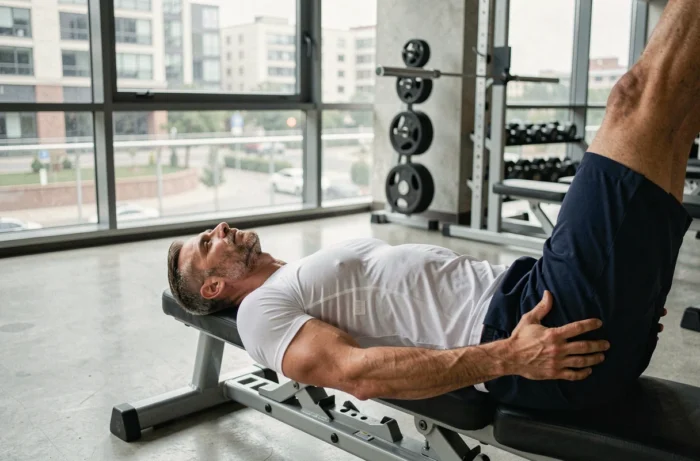
Lie on your back, gripping the edge of the bench behind your head, and raise your straight legs until they’re vertical, then lower them slowly. This movement targets the lower portion of the rectus abdominis. Keep the lowering phase controlled: if your lower back arches, bend your knees slightly to shorten the lever.
- Decline crunch: trunk flexion, upper rectus abdominis; suited to those looking to build muscle in the upper abs
- Plank with feet elevated: overall stabilization, transverse abdominis and obliques; useful for sports and everyday balance
- Leg raises on a flat bench: lower rectus abdominis; requires good lumbar control to remain effective
Returning after lower back discomfort: what the bench allows—and what it doesn’t
Many people return to bench ab exercises after a bout of back pain, thinking that strengthening their core will solve the problem. The ACSM notes that core stabilization exercises are not necessarily superior to other forms of exercise for back pain. The MSMC sports medicine center advises temporarily avoiding movements that worsen symptoms and consulting a professional if the pain is severe or accompanied by unusual symptoms.
When returning to exercise on a bench, start with movements that involve no incline and no extreme range of motion. A partial crunch on a flat bench, with your feet on the bench and knees bent at a right angle, reduces pressure on the lumbar discs. Curl only your shoulders, hold for two seconds at the top, then lower.
A full sit-up on an incline bench is the first movement to avoid when returning to exercise. The combination of the incline, the pull of the hip flexors, and the full range of motion places stress on the lower back that can bring back recent discomfort. It’s better to progress in stages: start with a flat bench, then add one incline notch after several pain-free weeks.
Frequency and common mistakes on a weight bench
Training your abs on a bench every day won’t produce better results than two or three sessions a week. Abdominal muscles recover faster than larger muscle groups, but they still need rest to get stronger.
- Common mistake: pulling on your neck with your hands during crunches, which compresses the cervical spine without adding abdominal work
- Common mistake: using momentum to raise your torso instead of controlling each phase of the movement
- Most costly mistake: increasing the incline too quickly without mastering the flat version, shifting the load to the psoas and lower back
Adding bench ab exercises at the end of a weight-training session, after compound exercises such as squats or deadlifts (which already engage the core for stabilization), lets you round out your workout without overloading your core. Two or three exercises, with three sets each, are enough for steady progress.
A weight bench isn’t a miracle piece of equipment for abs; it’s a tool for progression. Use it to adjust the difficulty, match the angle to the type of training you’re after, and respect your current limits. Choosing the right bench exercise for your goal delivers better results than habitually churning out incline sit-ups.