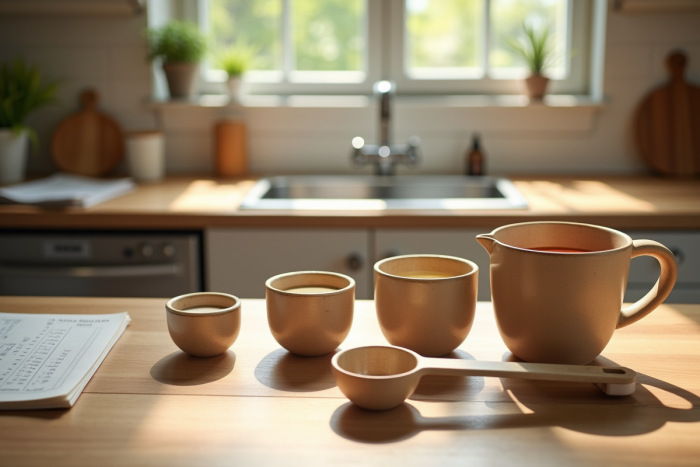
Every cook, whether amateur or professional, knows how frustrating it can be to juggle different units of measurement for liquid ingredients. An American recipe calls for cups, a European one uses milliliters, and confusion sets in. Fortunately, there are simple tricks to convert these measurements effortlessly and succeed in all culinary preparations.
Using tools like conversion charts or specialized mobile apps can save a meal. Keeping a few common equivalents in mind, such as one cup equaling 240 milliliters, can also save valuable time. Simplifying these conversions allows you to focus on what matters: the joy of cooking.
The basics for converting liquid measurements in cooking
To easily convert liquid measurements, a few basic concepts are enough. French cooking primarily uses milliliters and liters, while Anglo-Saxon recipes prefer cups. Understanding these equivalents greatly simplifies the task.
Common equivalents
- 1 cup = 240 ml
- 1/2 cup = 120 ml
- 1/3 cup = 80 ml
- 1/4 cup = 60 ml
These quick conversions allow you to follow any recipe without making mistakes. For example, if you are asked to measure 400 ml converted to l, know that this equals 0.4 liters.
Using conversion tools
Modern cooks have a variety of digital tools at their disposal to simplify these conversions. Specific mobile apps allow for instant measurement conversions. There are also printable conversion charts to display in the kitchen for quick access.
Some practical tips
When working with liquid measurements, use specific utensils like measuring jugs. They allow for precise measurement and help avoid common errors. Also, keep an eye on foreign recipes, which are often a source of inspiration but require precise conversions to stay true to the original flavors.
With these basics and tools, every cook can approach any recipe with confidence, turning cooking into a true pleasure.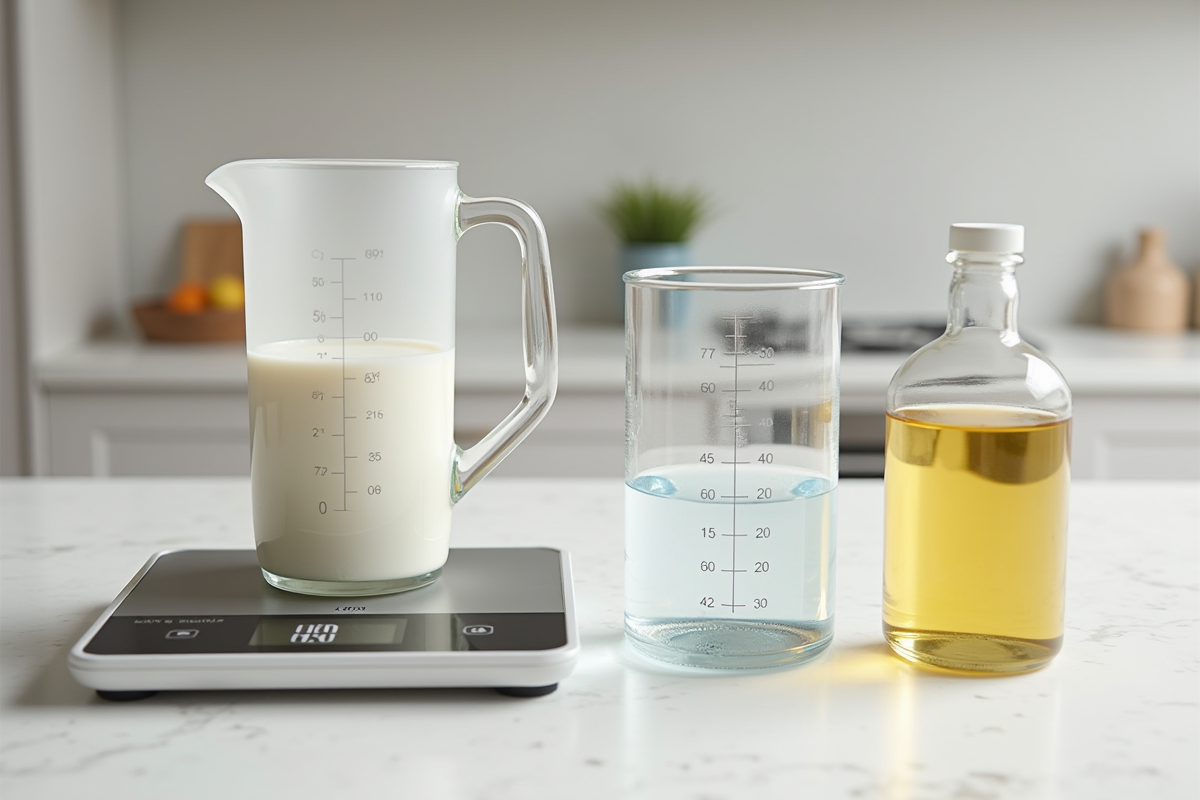
Techniques and tips for accurate conversions
For accurate conversions, a few techniques and tips are essential. Using digital tools like conversion apps remains an effective solution to avoid approximations.
Using conversion charts
Print conversion charts to display in your kitchen. These charts allow you to quickly find the equivalents between French and Anglo-Saxon measurements. For example, a chart might include:
| French measurement | Equivalent in cups |
|---|---|
| 250 ml | 1 cup |
| 125 ml | 1/2 cup |
| 60 ml | 1/4 cup |
Weighing for more precision
Weighing liquids is a reliable alternative. Use a kitchen scale that allows you to measure in grams and milliliters. This method ensures accurate conversions, especially for recipes requiring high precision like baking.
Specific utensils
Some utensils are particularly useful for conversions:
- Measuring jugs: allow you to measure directly in milliliters and cups.
- Measuring spoons: ideal for small quantities, often in milliliters and fractions of cups.
Mobile apps and voice assistants
Mobile conversion apps make work in the kitchen easier. They provide instant and accurate conversions. Voice assistants can also be helpful: ask your assistant to convert a measurement and get the answer in seconds.
With these techniques and tips, every cook can approach liquid measurement conversions with increased confidence, simplifying the preparation of international recipes.