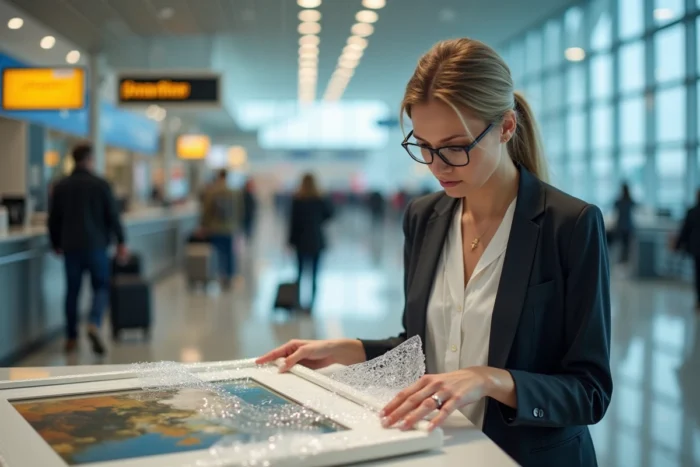
A simple oversight of a certificate can turn the transport of a work of art into an administrative headache. Between disparate regulations, restrictive insurance policies, and meticulous customs requirements, every detail matters to cross borders smoothly. A poorly prepared crate, careless labeling, and the artwork can end up stuck thousands of kilometers away from its owner. The slightest misstep weighs heavily on the balance. Carefully preparing the packaging and documents is the first line of defense to ensure that the artwork travels safely.
Transporting artworks by plane: what challenges and obligations to anticipate?
Transporting a work of art by plane involves juggling shifting and sometimes contradictory regulations. In Paris or elsewhere in France, specialists in secure transport know that a misunderstood rule can lead to a canvas being held up in customs. Authorities often require proof of origin, certificates of ownership, and sometimes an administrative green light even before considering departure. Without these keys, crossing the border is impossible.
The choice of mode of transport directly impacts the safety of the journey. Should one opt for a private jet, the cabin of a commercial airplane, or risk the cargo hold? Each solution has its limitations: airlines may have restrictions on size, specific packaging requirements, logistical constraints… For the cargo hold, a custom crate is essential. There is no compromise on packaging: explicit markings, precise tracking, everything is designed to minimize risks at every step.
Transporting a work of art by plane also means anticipating the unexpected: breakage, delays, loss. A dedicated insurance policy, tailored to the actual value of the item, whether ad valorem or nail to nail, is essential to cover any damage. Professionals consistently recommend creating a complete inventory and archiving dated photos of the artwork before transport. This vigilance prepares for all eventualities, from simple delays to accidents along the way.
To go further and obtain detailed advice at every stage, the file “transporting a work of art by plane” gathers recommendations and practical tips. A valuable ally for crossing borders and controls, whether for a temporary exhibition or during a move abroad.
Effectively protecting your artwork: practical tips for flawless packaging and handling
The transport of artworks does not allow for improvisation. It all starts with packaging: each piece deserves tailored attention. Paintings, sculptures, or collectibles all require protection designed for their specificities.
The custom crate remains the reference. It fits the dimensions of the artwork and is paired with protective foam shaped to limit movement inside, effectively absorbing shocks. Whether the journey is local or international, this precaution limits unpleasant surprises. Bubble wrap is used as a second layer, never directly on fragile surfaces; tissue paper serves as a buffer to avoid any unwanted marks.
Different types of artworks call for appropriate handling. Here are some concrete recommendations:
- For paintings, opt for reinforced corners and double protection, tissue paper, then bubble wrap, before placing in the crate.
- For sculptures, stabilize each movable element with foam wedges and securely fix the entire assembly inside the crate.
Handling also requires constant vigilance. Using gloves, adopting precise movements, and ensuring proper labeling, mentioning “fragile,” orientation, insured value, are essential. For air transport, hiring a professional experienced in handling artworks provides a real safety net. Document each step of the packaging with dated photos to have proof in case of disputes.
Thoughtful packaging and rigorous handling form the essential duo to preserve your artworks, regardless of the length or complexity of the journey.
Formalities, insurance, and customs: everything you need to know for a worry-free journey
Before considering takeoff, it is better to tackle the administrative mountain without delay. Each artwork must be declared to customs, even for a simple temporary loan, or risk being held up at the border. Regulations vary depending on the origin and destination: in France, certain artworks require specific authorization, especially if they are considered national heritage.
The issue of insurance should never be taken lightly. Nail to nail or ad valorem policies cover artworks from departure to arrival. Read the exclusions carefully, especially in case of a stopover or prolonged stay in international zones. The declared value at the time of subscription conditions any compensation: have a formal appraisal done to protect your interests.
Another often underestimated aspect: taxation. Exporting a work of art sometimes involves paying VAT or customs duties. It is therefore wise to check the agreements between France and the destination country to avoid any unexpected costs.
Here are the main documents to gather before departure:
- Invoice, certificate of authenticity, authorization to leave the territory, insurance policy: all these documents must travel with the artwork.
- A detailed inventory, accompanied by photographs, simplifies inspections and facilitates compensation if needed.
Precision and anticipation pave the way for a smooth transport. Gathering complete documentation and choosing appropriate insurance gives the artwork the best chance of arriving safely, even during complex transit or a change of carrier along the way. When every detail counts, the risk is minimized, and the mind can finally travel as lightly as the artwork itself.